No. 125 Maintenance Unit
This site holds 100 images from the National Archive displaying pages from the RAF Operations Record Book relating to No. 125 MU. They detail the path of the unit through WWII from January 1942 to April 1945.
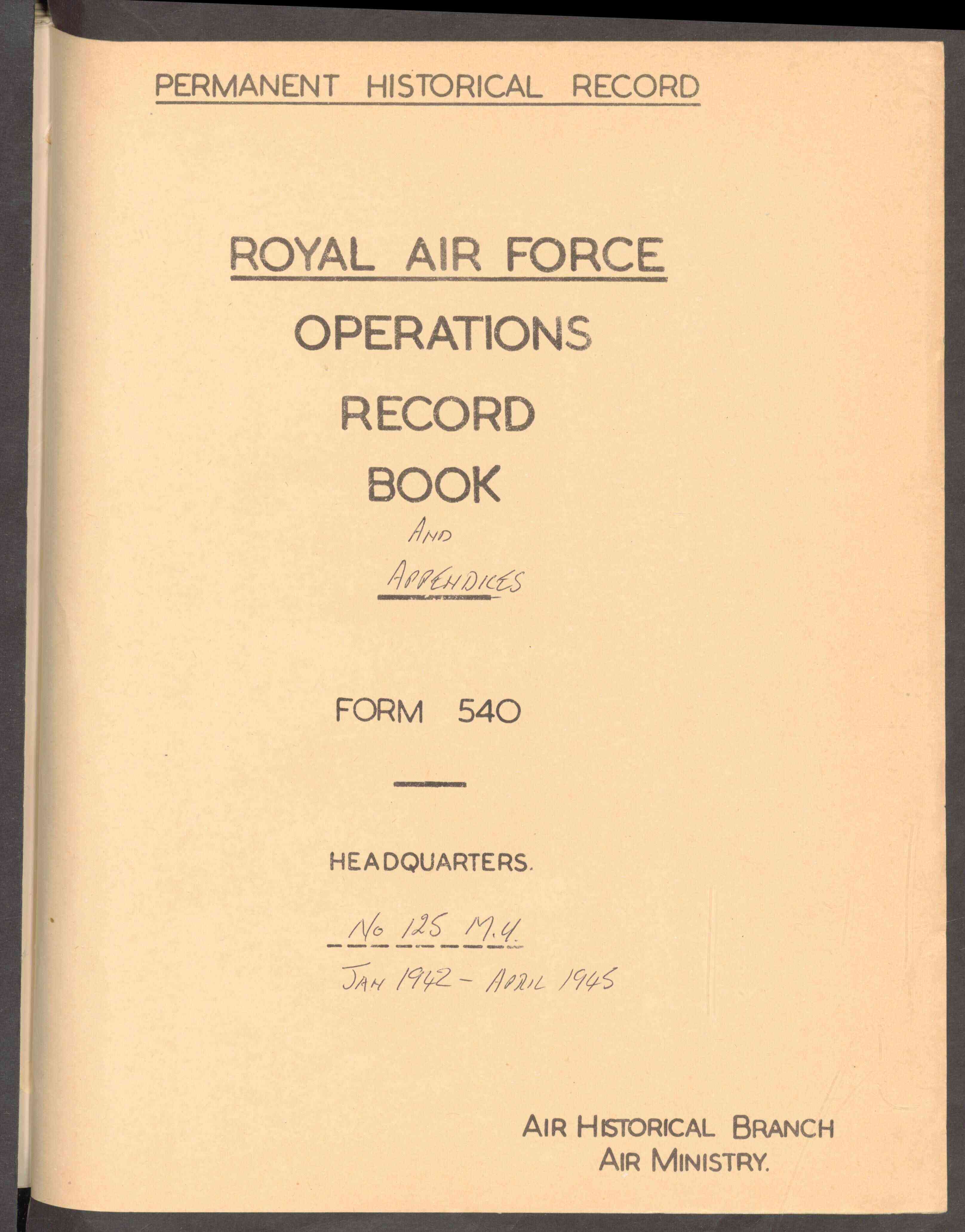
The images contain the monthly returns (Form 540 - Summary of Events) filed by the Squadron Leader. The pages are full of RAF jargon and colonial-era placename spellings. The settings are Iraq, North Africa and France and Italy.
To see an image click its button. Click the image to dismiss the image. Previously clicked buttons are shown blue. More than one image can be kept open.
Summary
The path of 125 MU, or detachments of 125 MU, was:
| Period | Location |
| January 1942 until February 1942 | Habbaniya (Iraq) on the Euphrates, W. of Baghdad RAF Habbaniya |
| February 1942 until October 1943 | Habbaniya, Kirkuk, Mosel etc (Iraq) |
| October 1943 until March 1944 | Massara (Egypt) near Cairo El Masara El Masara |
| March 1944 until May 1944 | Aboukir (Egypt) near Alexandria RAF Aboukir |
| April 1944 - | Corsica detachment (125 MU No. 1 Park) |
| May 1944 until July 1944 | Crescia | Cresia | Cressia (Algeria) Khraïcia |
| 11th June 1944 - | Sardinia detachment (125 MU No. 2 Park) |
| July 1944 until August 1944 | Caserta (Italy) near Naples Caserta Caserta |
| from August 1944 | Bouc-Bel-Air (France) near Marseille Bouc-Bel-Air |
| April 1945 | Gragnano (Italy) disbanded |
Background to operations
By early 1942, the RAF and British Army were moving large numbers of personnel into Iraq to reinforce RAF Habbaniya, RAF Shaibah, and the Persia & Iraq Force (Paiforce).
Paiforce was the Middle East theatre command created in September 1941 to control British and Commonwealth troops occupying Iraq and Iran after the Anglo-Iraqi War and the Anglo-Soviet invasion of Iran. Its main purpose was to secure oil fields, protect supply routes, and later manage the Persian Corridor, the vital supply line delivering material to the Soviet Union.
What Paiforce did
- Secured Iraq after the defeat of Rashid Ali's pro-Axis government (May 1941).
- Occupied Iran jointly with Soviet forces (August 1941) to prevent German influence and secure oil installations.
- Protected the Basra-Baghdad-Tehran axis, including key RAF and logistics bases.
- Ran the Persian Corridor, through which millions of tons of Allied supplies were shipped to the USSR from 1942 onward.
- Oversaw British and Commonwealth units, including Indian Army formations, RAF elements, and support services.
Background to Maintenance Units
RAF Maintenance Units (MUs) sat outside the operational flying commands (Fighter, Bomber, Coastal) and instead belonged to RAF Maintenance Command, organised into specialised Maintenance Groups (40, 41, 42, 43 Groups). They reported up a logistics and engineering chain rather than an operational one. This was so operational units could concentrate on engagement rather than logistics.
Maintenance Command was based at RAF Andover overseeing
- No. 40 Group - equipment storage (except bombs/explosives)
- No. 41 Group - aircraft storage, repair, overhaul
- No. 42 Group - fuel & ammunition storage
- No. 43 Group - salvage and recovery
Above Maintenance Command sat the Air Ministry, specifically the Directorate-General of Servicing and Maintenance (DGSM), which set policy for both home and overseas maintenance
Fuel and Ammunition Storage
42 Group was the RAF's dedicated armament logistics group. Its mission was to manage the RAF's armament and fuel supply chain, including:
- Storage of high-explosive bombs, incendiaries, and small-arms ammunition
- Storage and distribution of aviation fuel
- Operation of underground and surface ammunition depots
- Oversight of Air Ammunition Parks / Forward Ammunition Depots
- Ensuring safe handling, transport, and issue of explosives to airfields
- RAF Middle East Command Cairo, December 1941 - December 1943
- Air Headquarters Iraq Shabbiyah, renamed in January 1943 to Air Headquarters Persia and Iraq (AHQ P&I)
- Paiforce / Tenth Army Baghdad, for joint Army-RAF supply coordination
- The Middle East was a vast theatre with long supply lines (Basra → Baghdad → Kermanshah → Tehran). A UK-style centralised group system was impractical.
- Much of the ammunition and fuel supply was shared with the Army and Paiforce, so RAF logistics were integrated into broader Lines of Communication.
- Abadan refinery (downriver from Basra but in Persia) produced aviation fuel locally, so fuel logistics were tied to refinery output rather than UK import depots.
- RAF Armament Depots (Middle East)
- RAF Fuel Depots (Middle East)
- Air Ammunition Parks (Middle East)
- Station Armament Sections
Air Ammunition Parks (Middle East)
AAPs were placed to:
- receive bombs from ships (Basra/Maqil)
- store them at secure inland bases (Shaibah, Habbaniya)
- push them forward to Persia (Khanaqin/Mandali)
- and support RAF flying operations across the theatre
- All ammunition storage and explosive safety
- Receipt and issue of bombs, fuzes, detonators, small-arms ammunition
- Inspection and quality control
- Liaison with RAF stations and Army ammunition depots
- Personnel management (armament NCOs, examiners, labourers)
- Security of the depot
- Compliance with Air Ministry explosive regulations
An AAP manages ammunition dumps at several locations, referred to as sites. If the MU is split organisationally into detachments these are known as Parks, e.g. 125 MU No. 1 Park.
Arrival at Basra
January 1942
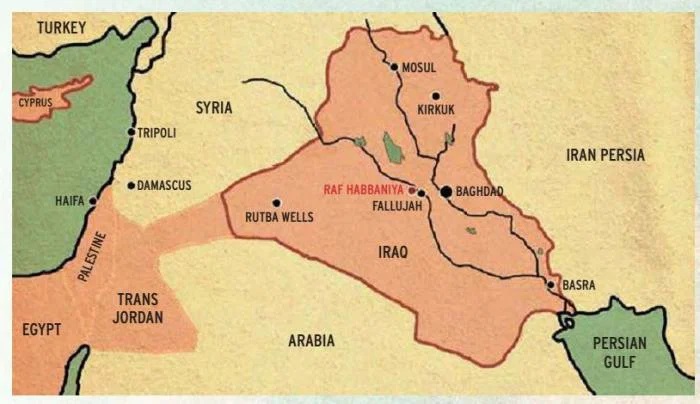
The leader of 125 MU commands an AAP reporting to a Senior Armament Officer at RAF Shaibah (near Shu'aiba outside of Basra).
125 MU is 8 officers, 4 sergeants and 151 other ranks. They arrive at "Margil", Basra on the 18th January 1942.
Margil (Al Ma'qil) is a site within the port district of Basra, on the west bank of the Shatt-al-Arab river, 2-3 miles North West of Basra city. It was a distinct hub used heavily by the British from WWI through WWII where military stores, personnel and vehicles were landed. Part of the Iraq State Railways network, it connected directly to the Basra-Baghdad line.
The unit has 6 days of training and recreation at Margil before taking an overnight train to Baghdad and driving on for 3 hours to Habbaniya.
3 P/Os get a temporary duty assignment to Shaibah and then travel on to Habbaniya
At Habbaniya the sub-units of 125 MU and their responsibilities are determined.
Habbaniya
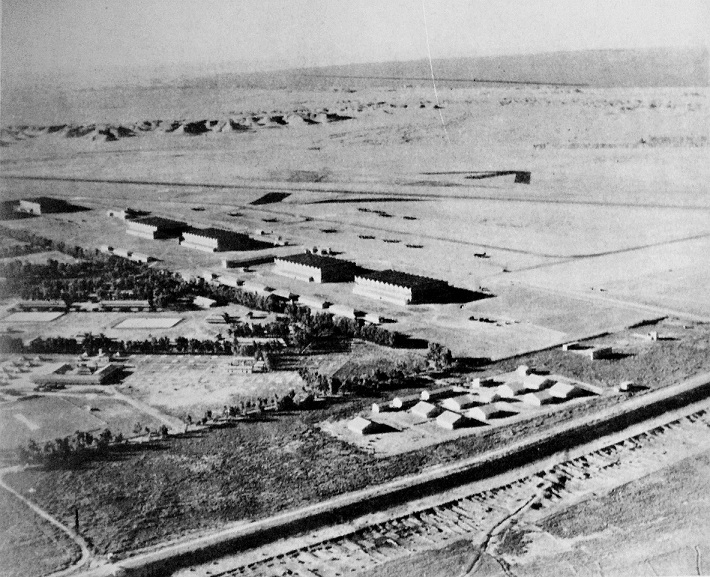
Work starts at various sites.
| Name | References |
| Ducksbill | Near Basra. The RAF nickname for the Daqiqah (or Daqiqah Camp / Daqiqah Transit Depot) area used as a major transit, staging, and supply point for personnel moving into or out of Iraq. Now called Dakeer Dockyard |
| Habbaniya | West of Baghdad, central Iraq |
| Kirkuk | Northern Area of Iraq, see map above |
| Qaiyara | Northwest of Kirkuk. Qaiyara, |
| Mosul | Northern Area of Iraq, above Kirkuk, see map above |
| Ain Zala | North-west of Mosul. Ain Zala |
February 1942
March 1942
April 1942
May 1942
June 1942
July 1942
August 1942
September 1942
October 1942
November 1942
December 1942
January 1943
February 1943
Recap of previous 13 months
March 1943
Summary of March 1943
April 1943
Summary of April 1944
May 1943
The North Africa campaign concludes in May 1943
June 1943
July 1943
On 10 July 1943 the Allies invaded Sicily (Operation Husky).
August 1943
September 1943
October 1943
On 14th October 125 MU are at Habbaniya and ordered to leave for "Middle East 101 MU Masara"
The travelling party are 4 Officers 5 SNCOs and 84 airmen with 27 vehicles.
On 20th October leave at 06:00, arriving at Rutbah 18:00 and camp at the staging post area.
On 21st October leave for H4 Staging post
On 22nd October leave for Mafraq
On 23rd October leave for Jerusalem
On 24th October leave for staging post in Sinai desert
On 25th October leave for Canal Staging post
On 26th October leave at 6.00 for 101 MU arriving 12.00
Egypt
Massara
Tura (a.k.a. Tourah | Turah | Maslaha Tora) is a limestone quarry in the administrative district of Massara (a.k.a. Masara, Masarah, El-Massara, El Ma'sara) in Cairo. RAF Tura was a sub-depot of the RAF Middle East Supply Organisation and the base of 101 MU located at Tura. The RAF site occupied the flat ground between the quarries and the river, 2-3km north of modern Helwan, on the east bank of the Nile, about 10-12 km south-southeast of central Cairo. It stored aircraft spares; fuel; munitions; engineering materials; general stores for RAF units.
Tura was used because
- Existing underground caverns (the ancient limestone quarries) offered natural protection from bombing.
- Rail access: a branch line connected Tura to Cairo and to Helwan.
- River access: Nile barges could deliver bulk supplies.
- Road access: the Old Cairo to Helwan road ran directly past the site.
- Security: the area was sparsely populated in 1943 and easy to guard.
November 1943
Unit lodging with 101MU. Lull in activities allowing leave. Sten gun training.
December 1943
Christmas celebrations.
January 1944
February 1944
Massara and Aboukir
March 1944
Algiers, Aboukir, Corsica, Benghazi, Tripoli
April 1944
Small advance party to Corsica setting up No.1 Park of 125 M.U. assisted there by Yugoslavs who were loaned from Americans.
2400 mile trip of convoy from Aboukir to Algiers
Unit moved through Mersa Matruh, Agedabia, Marbel Arch, Sultan, Misurata, Tripoli
Unit moved through Gabes, Sousse, Tunis, Souk-Ahras, Setif
Crescia (main unit) and Corsica (No. 1 Park)
May 1944
In Crescia 125 M U took over ammunition from an army unit
Barbed wire erected to keep out local thieves.
Investigation into the spontaneous combustion of smoke bombs.
A second detachment (No. 2 Park) prepares to leave for Sardinia.
Reorganisation of explosives supply
Map showing Cressia and nearby locations
June 1944
July 1944
September 1944
October 1944
November 1944
December 1944
January 1944
February 1945
March and April 1945
Appendices
Glossary
| Term | Meaning |
| Form 540 | The Summary of Events, it was paired with Form 541, the Detail of Work Carried Out, which listed individual sorties.
540 is a daily or monthly narrative describing:
|
| MAAF | The Mediterranean Allied Air Forces (MAAF) was the major Allied air force command organization in the Mediterranean theater from mid-December 1943 until the end of the Second World War. They were headquartered in Caserta, Italy in 1944. |
| MAAF Rear | The support and administrative headquarters in Cairo. It handled personnel administration, records, training, logistics, medical services, liason |
| PTC | Personnel Training Centre, a physical induction/training establishment. |
| No 24 PTC | Located at Royal Air Force Cardington, Bedfordshire, during the Second World War |
| M.E. Command | RAF Middle East Command's senior leadership (e.g., Air Chief Marshal Tedder) operated from Air House in Cairo |
| SAAF | South African Air Force, an active Allied air arm operating in East Africa, North Africa, Madagascar, Italy, and the Mediterranean. |
| POL | Petrol, Oil and Lubricants |
AAPs in the Middle East
| Name | Location | Why it was there particularly |
| Habbaniya AAP; Armament Depot | Habbaniya itself; ~55 miles west of Baghdad | Major RAF base and AHQ Iraq; ideal for central theatre armament storage, relatively secure inland site on Euphrates, supporting Iraq defence and training. |
| Shaibah AAP; Armament Depot | Basra ~8 miles east; within Shaibah cantonment | Close to Basra port and railhead; key RAF station for receiving bombs ex-ship and feeding inland AAPs and stations (Habbaniya, Mosul, Persia). |
| Margil AAP | Basra ~2-3 miles NW along Shatt-al-Arab | Primary British military port; ideal for first-line reception, storage, and break-bulk of imported ammunition before onward movement by rail/river to Iraq and Persia. |
| Abadan AAP; Armament & POL depot | Abadan city; refinery complex ~6 miles across river from Basra | Co-located with refinery and port; combined fuel and armament hub for Persian Corridor, supporting RAF units in southern Persia and joint Paiforce logistics. |
| Kermanshah AAP | Kermanshah, western Iran; depot on outskirts | Rail and road junction on Basra-Baghdad-Tehran axis; ideal inland ammunition park feeding Hamadan/Tehran and Soviet-bound Lend-Lease traffic. Lend-lease was a policy under which the United States supplied the United Kingdom, the Soviet Union, France, the Republic of China, and other Allied nations of the Second World War with food, oil, and materiel between 1941 and 1945. |
| Hamadan AAP | Hamadan, western Iran; short distance from town | High-ground inland site, away from coast; supported RAF and Army forces guarding central section of Persian Corridor and airfields in western Iran. |
| Ismailia AAP; Armament Depot | Ismailia, Egypt; a few miles from town on Canal | Canal-side hub near major RAF stations; supplied Canal Zone airfields and Middle East Command units, with good port/rail access and dispersal space. |
| Kasfareet; Geneifa AAP-type stores | Ismailia ~15-20 miles SW; on west side of Canal | Large logistics and maintenance hub (107 MU, transit centres); natural site for bulk armament storage supporting Egypt/Palestine air operations. |